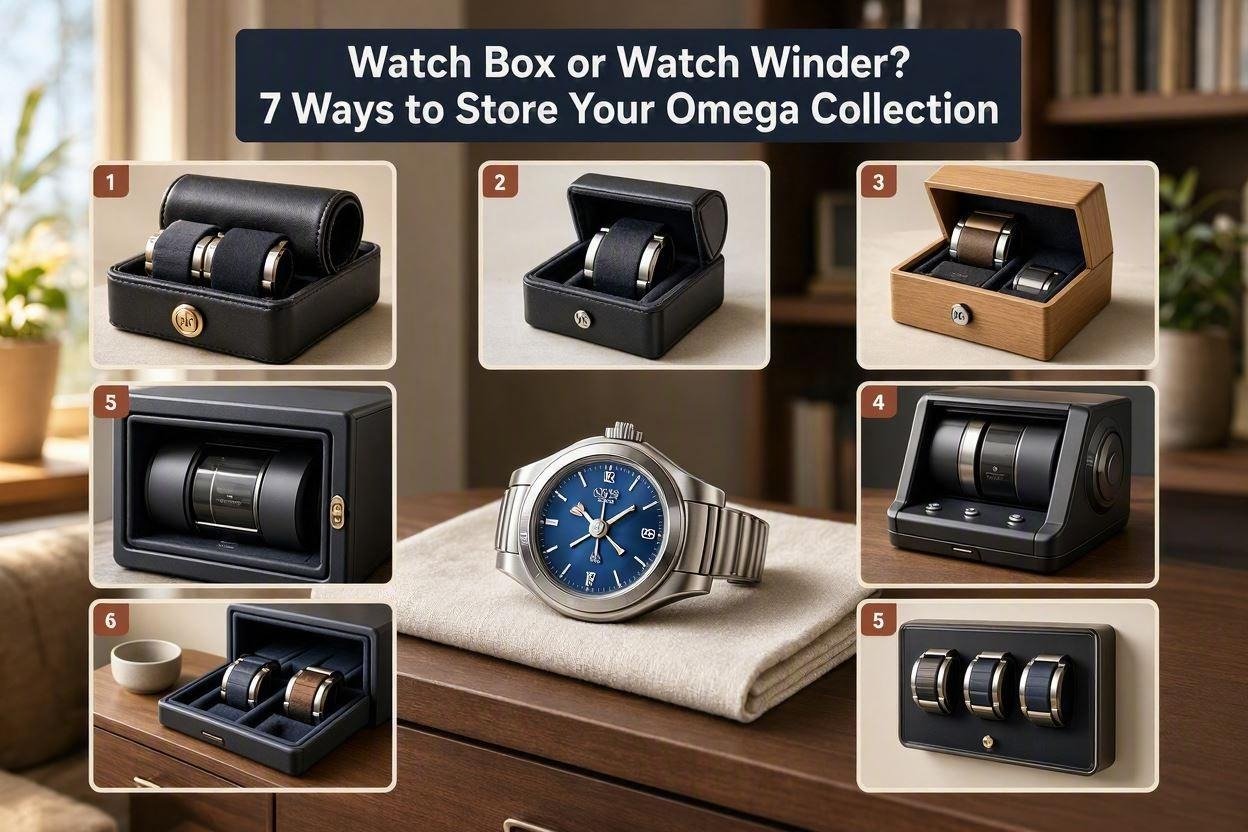
Watch Box or Watch Winder? 7 Ways to Store Your Omega Collection
An Omega deserves better than a bedside table or a jumble in a drawer. Whether you own a Seamaster you wear every weekend or a Speedmaster you save for special days, how you store your watches affects how they look, how they run, and how much you enjoy them.
Two products dominate the conversation: the watch box and the watch winder. They solve different problems, and many collectors wonder which one to buy first. This guide walks through seven practical points so you can choose the right storage for your Omega collection.
1. Understand What Each One Does
A watch box protects your watches, while a watch winder keeps automatic watches running. That distinction settles most of the debate.
A watch box stores your watches in individual cushioned slots. It shields them from dust, light, scratches, and knocks. It does nothing to the movement, so an automatic watch in a box will stop once its power reserve runs down.
A watch winder rotates your automatic watch at set intervals, which swings the rotor and keeps the mainspring topped up. The watch stays on the correct time and date, ready to wear. A winder offers little physical protection, though, and it does not suit every watch you own.
Think of a box as storage and a winder as a convenience. Most serious collectors end up using both.
2. Sort Your Omegas by Movement Type
Not every Omega needs winding, so start by checking what powers each watch.
- Automatic Co-Axial models: Seamaster, Aqua Terra, and Constellation watches with self-winding calibres benefit from a winder if you rotate them often.
- Manual-wind models: The Speedmaster Professional Moonwatch uses a hand-wound movement. A winder does nothing for it, so a box suits it better.
- Quartz models: Battery-powered Omegas never need winding. A box keeps them clean and safe.
Many Omega automatics run for around 50 to 60 hours on a full wind, depending on the calibre. A watch you wear once a fortnight will stop between wears, and a winder saves you from resetting the date, the GMT hand, or the chronograph each time.
If you plan to buy for your Seamasters and Aqua Terras specifically, a guide to best watch winders for Omega watches explains which settings and features suit each family.
3. Count How Often You Wear Each Watch
Wear frequency decides more than any specification does.
If you wear a watch at least every two or three days, it rarely needs a winder. The wrist keeps the mainspring wound, and the watch never stops long enough to bother you.
Winders earn their place in these situations:
- You rotate between four or five watches and wear each one occasionally.
- Your watch has a complication, such as an annual calendar or GMT function, that takes time to reset.
- You travel often and want your watches to stay accurate until you return.
- You simply prefer to pick up any watch and see the right time.
If you wear one Omega daily, a good box costs less and serves you better. If you rotate a larger collection, a winder saves real effort.
4. Protect Your Watches From Everyday Damage
A winder keeps a watch running, but it does not shield it from the things that quietly damage a collection. A box handles those.
Dust and grit. Fine particles settle on crystals, cases, and bracelets. They work into the gaps around crowns and pushers over time.
Scratches and knocks. Watches that touch each other or a hard surface pick up hairline marks on polished cases and bezels. Individual cushions keep them apart.
Light and moisture. Direct sunlight fades dials, straps, and leather linings. Damp air can stain leather straps and encourage mould. A closed box with a lined interior slows both problems.
The top Aevitas Watch Boxes come in configurations from a single watch up to large multi-watch cases, so you can match the size to your collection and store each Omega safely between wears.
5. Check Magnetism, Noise, and Build Quality
If you decide to add a winder, three details separate a good one from a disappointing one.
Motor quality. A well-made motor runs almost silently and lasts for years. A cheap one hums, vibrates, and fails early. That matters if the winder sits in a bedroom or study.
Magnetism. Strong magnetic fields can make a mechanical watch run fast. Omega has built a strong reputation here. Its Master Chronometer watches undergo testing at the Swiss Federal Institute of Metrology, and the METAS testing standard includes resistance to very strong magnetic fields. A modern Master Chronometer handles magnetism better than most watches, but a low-magnetism motor still protects older Omegas and keeps rate accuracy consistent.
Cushion fit. The cushion must grip the bracelet or strap firmly without crushing it. A loose fit lets the watch slip, and an over-tight one strains the case and strap.
6. Set the Winder Correctly
A winder only helps when you configure it properly. Two settings matter most.
Turns per day. TPD measures how many full rotations the winder completes in 24 hours. Many modern automatics perform well between roughly 650 and 800 TPD, but the right number depends on the calibre. Check your Omega’s manual or ask an authorised watchmaker before you choose a setting.
Rotation direction. Most modern Omega automatics wind in both directions, so a bidirectional setting works well. Some older movements prefer one direction, so choose a winder that offers clockwise, counterclockwise, and bidirectional modes.
More rotation does not help. A slipping clutch inside the movement prevents overwinding, but constant turning adds unnecessary wear. Pick a winder with timed cycles and rest periods, and let it run a normal schedule.
7. Build a Setup That Grows With You
The best storage plan considers where your collection will stand in two years, not only today.
Follow this simple approach:
- List your watches and mark which ones are automatic, manual-wind, or quartz.
- Assign winder slots only to the automatics you rotate regularly.
- Store everything else in a box, including manual-wind watches, quartz watches, and any watch you rarely wear.
- Leave room to expand. A four- or six-slot unit costs less than replacing a small one later.
- Choose a secure, dry location. A bedroom cabinet, dressing table, or study shelf works well. Avoid bathrooms, windowsills, and radiators.
This hybrid approach gives you the best of both. Your everyday rotation stays wound and ready, and the rest of the collection sits safely protected. Collectors often ask the team at Aevitas how to split their collection between winder slots and box storage, and the answer almost always comes down to how often they wear each piece.
Final Thoughts
A watch box and a watch winder do different jobs, and neither replaces the other. A box protects every watch you own, and a winder keeps the automatics you rotate ready to wear. Manual-wind models like the Speedmaster Moonwatch and quartz Omegas belong in a box, while frequently rotated Seamasters and Aqua Terras gain the most from winding.
Start with the watches you own and the way you wear them. Add protection first, then add winding where it saves you effort. That order keeps your collection safe, accurate, and enjoyable for many years.
FAQs
Do Omega watches need a watch winder?
No, Omega watches do not need a winder. A watch runs perfectly well if you wear it regularly or reset it after it stops. A winder simply saves you the effort of resetting the time and date, which helps when you own several automatics.
Is a watch box or a watch winder better?
Neither is better in general. A box protects watches from dust, scratches, and light, while a winder keeps automatic movements running. Most collectors use a winder for the watches they rotate often and a box for everything else.
Does the Speedmaster Moonwatch need a winder?
No. The Speedmaster Professional uses a manual-wind movement with no rotor, so a winder has nothing to turn. Wind it by hand and store it in a watch box between wears.
How many turns per day does an Omega need?
Many modern automatic watches perform well at roughly 650 to 800 turns per day, but the exact figure depends on the calibre. Check your Omega’s manual or ask an authorised watchmaker before you choose a setting.
Can a watch winder damage an Omega?
A quality winder set to the correct turns per day will not damage an Omega. Problems come from poorly made motors, strong magnetic fields, or excessive winding. Choose a winder with adjustable settings and low magnetic interference.
Should I leave my Omega in a winder all the time?
You can, but timed cycles with rest periods work best, and you should still wear the watch regularly. For long-term storage, let the watch run down and keep it in a dry, secure box.